LEGO Serious Play: Why Serious Organisations Are Building Their Way to Better Conversations
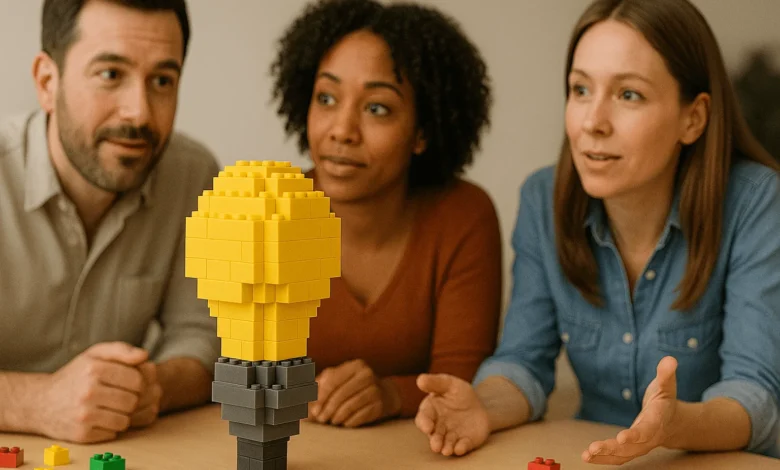
Picture a leadership team that has been circling the same strategic question for months. The two most confident voices dominate every meeting, and the quieter members, who often have the most useful insights, barely say a word. Now picture that same group using LEGO® SERIOUS PLAY®, each person with a handful of bricks, building a model that answers the question: “What’s really getting in the way of our growth?”
Within twenty minutes, everyone has built something, and everyone has explained it. The conversation that follows is noticeably more honest.
That’s the basic idea behind LEGO Serious Play, a facilitated workshop method that uses hands-on building to help groups think, communicate and solve problems. It can sound like a gimmick at first. In practice, it’s one of the more effective ways to get a room of busy professionals to engage deeply with a hard question. This article explains how it works, where it’s most useful and what to consider if you’re looking at LEGO Serious Play in Australia for your own team.
What Is LEGO Serious Play?
It’s a structured facilitation method in which participants build three-dimensional models to represent ideas, challenges or goals, then use those models to share and discuss their thinking. It isn’t about building impressive structures. Some of the most powerful models in a session are just a few bricks stuck together.
The method has an interesting history. It emerged in the mid-1990s, when the company behind the bricks was looking for better ways to spark imagination and innovation internally. Its owner at the time worked with two business school professors in Switzerland to explore alternatives to traditional strategic planning, and they found that adults could use the bricks to build three-dimensional models of business issues and future strategy. In 2010, the method moved to an open-source model, which means trained facilitators around the world can now deliver it without a licence from the company itself.
At the heart of every session is a simple cycle:
- The facilitator poses a carefully designed question or challenge.
- Each participant builds a model that represents their answer, usually within a few minutes.
- Everyone explains their model to the group, telling the story of what each part means.
- The group asks questions about the models, looks for patterns and draws out insights.
The rules are few but important. Everyone builds. Everyone shares. And the model, not the person, is the focus of questions, which makes it easier to discuss sensitive topics without anyone feeling personally attacked.
Why Building With Your Hands Changes the Conversation
It’s fair to ask why bricks would produce better outcomes than a whiteboard and a set of sticky notes. There are a few reasons the approach works so well.
It gives everyone a voice. In a typical meeting, a small number of people do most of the talking. In these workshops, every participant builds and shares, so the quieter members of the group contribute just as much as the most vocal.
It slows down the rush to answers. Building takes a few minutes, and during that time people think more carefully about their response instead of reaching for the first thing that comes to mind.
It makes abstract ideas concrete. Words like “culture”, “alignment” and “silos” mean different things to different people. When someone builds a model of what a silo looks like in their part of the business, the group can literally see it, point to it and discuss it.
It lowers defensiveness. Criticising a person’s idea can feel personal. Asking “Why is this piece so far away from the rest of the model?” feels much safer, and often gets to the heart of the issue faster.
It builds shared understanding. Later stages of the method often involve groups combining individual models into a shared model, which is a powerful way to reach alignment on a vision, a set of values or a strategy.
Where LEGO Serious Play Team Building Works Best
The method is flexible, but it tends to shine in a few particular situations.
Team building with real substance
Many team-building days are fun but forgettable. LEGO Serious Play team building is different because the activity is also the work. Teams can explore how they operate, what they need from each other, where friction comes from and what a great team looks like to them. The result is a shared picture, often literally a shared model, that the group can refer back to long after the day ends.
Strategy and planning
Leadership teams use the method to explore future scenarios, test assumptions and identify what’s really driving or blocking performance. Because everyone contributes, the resulting strategy is more likely to reflect the full range of perspectives in the room, and more likely to have genuine buy-in.
Change management
During restructures, mergers or major system changes, people often have concerns they won’t voice in a standard meeting. Building models of “what this change means for me” or “what worries me about the next six months” brings those concerns to the surface in a constructive way, giving leaders a chance to address them early.
Leadership development
The method helps leaders reflect on their own style, explore challenges they face and experiment with new ways of approaching problems in a low-risk setting.
Wellbeing and resilience
Some facilitators use the approach to help teams talk about stress, workload and coping strategies. Building a model can make it easier to express difficult feelings than simply talking about them.
What to Expect From a LEGO Serious Play Workshop
If you’ve never taken part in a session, here’s roughly how a session unfolds.
Warm-up and skills building. The session usually opens with a few quick exercises to get people comfortable with building and with using models as metaphors. Even the most sceptical participants tend to relax after the first round.
Individual builds. Participants respond to a series of questions linked to the workshop’s objective. Each build is followed by sharing and reflection.
Shared models. For many objectives, the group works together to combine individual models into a shared landscape or a single collective model.
Insights and actions. The facilitator helps the group draw out themes, agreements and next steps, which are often captured with photos of the models and written notes.
Sessions can range from a short energiser at a conference to a half-day or full-day intensive, depending on the objective. Group sizes vary too, although smaller groups allow more time for each person to share.
Choosing a LEGO Serious Play Facilitator in Australia
Because the method is open source, anyone can technically run a session. That makes choosing the right facilitator especially important. The quality of the questions, the pacing and the way reflection is handled all depend on the facilitator’s skill and experience.
When comparing LEGO Serious Play Australia providers, consider:
- Training and accreditation. Ask how the facilitator was trained, and by whom. Formal training in the method makes a real difference to the quality of the session.
- Experience with your type of challenge. Running a strategy session for an executive team is quite different from a team-building day for a new department.
- Workshop design. A good facilitator will spend time understanding your objectives before the day and design the questions around them, rather than running a standard script.
- Location and delivery. Some facilitators travel nationally, including to regional areas, while others work within one city. Check logistics early, particularly if your team is spread across states.
- Follow-up. Ask how insights are captured and shared after the workshop, and whether there’s support for turning outcomes into action.
It’s also worth thinking about how a session fits into your broader development plans. Organisations get the most value when workshops connect to a real business question rather than being booked as a stand-alone event. If you’re planning something bigger, look for providers who can tailor LEGO Serious Play workshops for leadership, change and team building around a specific objective.
Getting the Most From Your Session: Before and After
The workshop itself is only part of the story. What happens either side of it often decides whether the insights turn into anything.
Before the workshop, get clear on a single objective. “Improve teamwork” is too vague to design questions around. “Agree on how our two merged teams will share work and make decisions” gives a facilitator something concrete to build a session on. It also helps to brief participants in advance: let them know it’s a hands-on session, that no building skill is needed and that the purpose is a real business conversation. That small step takes the edge off any scepticism before people walk in.
Think carefully about who’s in the room, too. The method works best when the people who need to agree on something are all present. Leaving out a key decision-maker can mean the group reaches a shared view that later gets overturned.
After the workshop, move quickly. Photos of the models, a short summary of the key insights and a list of agreed actions should be shared within a few days while the conversation is still fresh. Many teams find it useful to keep a photo of their shared model somewhere visible, such as the first slide of a team meeting deck, as a reminder of what they committed to.
Finally, schedule a check-in. A short follow-up conversation six to eight weeks later, asking what’s changed and what hasn’t, keeps the outcomes alive. Some organisations use a second, shorter session to revisit the shared model and update it as circumstances change. Treated this way, LEGO Serious Play team building becomes part of an ongoing conversation rather than a memorable day that fades by the next quarter.
Common Questions and Misconceptions
“Isn’t this just for creative teams?” Not at all. The method is used by accountants, engineers, government agencies, universities and executive teams. In fact, groups who don’t think of themselves as creative often get the most out of it.
“Our people will think it’s childish.” Some scepticism is normal at the start. It usually fades quickly once people realise the questions are serious and the conversations are real.
“Do you need to be good at building?” No. The models are metaphors, not works of art. A single brick can carry a lot of meaning.
“Can it work online?” Some facilitators run adapted virtual sessions, but most practitioners find the method works best in person, where people can see and handle each other’s models.
Conclusion
The method works because it changes the dynamics of a room. It gives every person a voice, slows down the rush to easy answers and turns abstract ideas into something people can see and discuss. Whether the goal is stronger teamwork, clearer strategy or smoother change, the method helps groups have the conversations they need but often avoid.
For Australian organisations, the method offers a practical alternative to both the dull strategy offsite and the forgettable team-building day. The key is to start with a clear objective, choose an experienced facilitator and plan how you’ll carry the insights forward once the bricks are packed away.
Used well, a few hundred small plastic pieces can open up thinking that months of regular meetings didn’t. That’s not play for the sake of it. It’s a serious tool for serious work.