Learn How to Prove Triangle Congruence with SAS Geometry
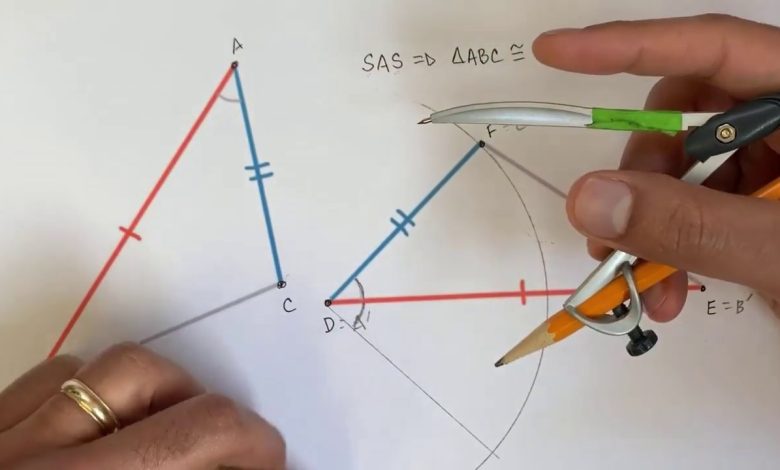
One of the most fascinating parts of geometry is how we can prove that two shapes are the same, especially triangles. To make sense of this, mathematicians use something called the SAS geometry, a simple but reliable method for proving that two triangles are congruent.
Whether you’re a student trying to pass your next test or someone who’s curious about how triangles work, this blog will help you leave with a solid understanding of this key concept.
Let’s get started!
What Does SAS Geometry Mean?
First, let’s break down the term SAS.
SAS stands for Side-Angle-Side. It’s a method used in geometry to prove that two triangles are congruent. Congruent means the same shape and size. The two triangles might be flipped, rotated, or turned upside down, but if they’re congruent, they’re identical in every way.
So, how does SAS work?
You can prove that two triangles are congruent if the following conditions match –
- One side of a triangle.
- The angle between the two sides.
- Another side of the triangle.
If two sides and the angle between them of one triangle are the same as two sides and the angle between them of another triangle, then the two triangles are congruent.
How Does SAS Geometry Work?
See the step-by-step explanation below of how SAS geometry works.
- Step 1: Find Two Triangles
Start by identifying two triangles that you think might be congruent.
For example, imagine you have two triangles, Triangle ABC and Triangle DEF.
- Step 2: Compare a Side
Check if one side of Triangle ABC is precisely the same length as one side of Triangle DEF.
Let’s say AB = DE.
- Step 3: Compare the Angle Between the Sides
Next, check if the angle between that side and another side is the same in both triangles.
For example, ∠B = ∠E.
- Step 4: Compare the Second Side
Finally, check if the second side connected to that angle is the same length in both triangles.
For example, BC = EF.
Therefore, if all three of these match up, the two triangles are congruent by the SAS rule.
Why Does the Angle Have to Be Between the Sides?
You might be wondering: “Why does the angle have to be between the two sides? Can’t it be any angle?”
Good question! The reason the angle must be between the two sides is that it “locks” the sides into a specific shape. If the angle wasn’t in between them, the triangle could swing open or closed like a door, changing its shape. By using the included angle, we make sure that the triangle can only form in one specific way. That’s why the SAS rule works.
Why Does SAS Geometry Matter?
Now, you might be thinking, why should you care about SAS geometry?
Remember, SAS is a vital math rule for understanding how shapes work together. Geometry is the foundation for many careers and fields, including:
- Architecture.
- Engineering.
- Computer graphics and animation.
- Robotics.
- Physics.
When you understand SAS geometry, you can solve problems logically, think critically, and build things that actually work in the real world.
Real-Life Example of SAS Geometry
Let’s look at a real-life scenario to help make sense of SAS Geometry.
Imagine you’re designing a garden. You want to make two triangular flower beds on either side of a walkway. To make sure they’re perfectly symmetrical, you measure:
- One side of each triangle is to be 4 feet long.
- The angle next to that side is to be 45 degrees.
- The second side is to be 3 feet long.
Because the two triangles have the same two sides and the same angle between them, both flower beds will turn out the same.
Common Mistakes to Avoid
Even though SAS Geometry is simple, there are a few common mistakes students make when using it.
- Using the Wrong Angle
Remember, the angle you use has to be between the two sides you’re comparing. If you pick an angle that’s not between the two sides, SAS doesn’t apply.
- Mixing Up the Order
It has to be Side-Angle-Side, not Angle-Side-Side or Side-Side-Angle. These other combinations don’t always prove congruence. Geometry is picky that way!
- Assuming Things are Congruent Without Proof
Just because two triangles look the same doesn’t mean they are. SAS Geometry gives you the solid proof you need to back up your claim.
Other Triangle Congruence Rules
SAS is just one method for proving triangles are congruent. There are others, including:
- SSS (Side-Side-Side): All three sides match.
- ASA (Angle-Side-Angle): Two angles and the side between them match.
- AAS (Angle-Angle-Side): Two angles and a non-included side match.
- HL (Hypotenuse-Leg): For right triangles, if the hypotenuse and one leg are the same, the triangles are congruent.
However, the SAS method is usually the most widely used, especially in construction and design.
Last Words
Whether you’re working on homework, curious about architecture, or just want to feel more confident in geometry class, mastering the Side-Angle-Side method is a great step forward.
But, still, if you can’t understand how these work or even require more knowledge, you can book online tutoring sessions from reputed platforms. There are many math teaching platforms available online that teach basic to advanced math concepts with 1:1 sessions, including SAS geometry.